


Are Contact Prescriptions the Same as Glasses?
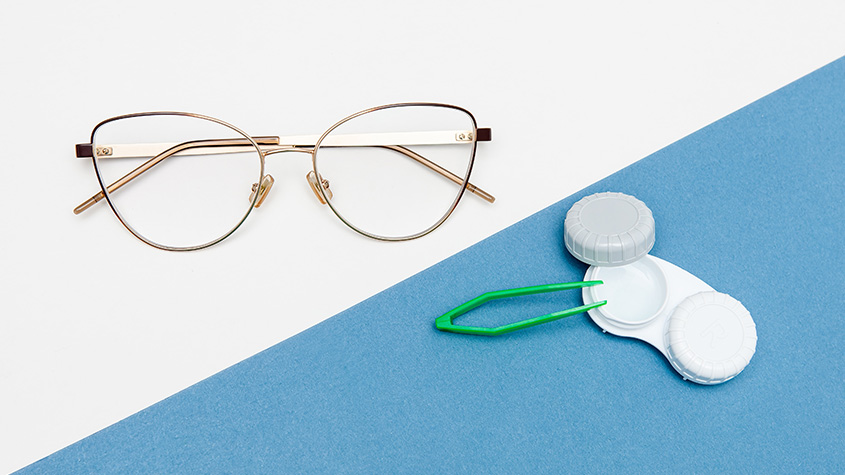
When you’re running low on your contact lenses or your glasses need an update, your optometrist is the one to turn to. Everything you need to support your visual health is all in one place! However, the details that go into every appointment and prescription update are precise for a reason. So, if you’re thinking that replenishing your contact lens supply is easy if you have a valid eyeglasses prescription, think again.
No, contact lenses and glasses do not share the same prescription.
If you’re lucky enough to have a copy of both prescriptions on hand, go ahead and take a look. You’ll notice that the numbers are similar, which accounts for the distinct way each corrective method interacts with your eye.
Whether a pro with contact lenses or wearing them for the first time, one thing is certain: everyone benefits from an annual contact lens exam and fitting.
Contacts vs Glasses Prescription: The Key Differences
Here’s the thing about vision correction: where you place the lens matters. A lot.
Glasses are a lot bulkier than contacts. These flexible and delicate lenses are small and made to sit directly on the eye’s surface, and are constantly interacting with your eye.
Glasses do not compare in that department. They rest comfortably on the bridge of your nose, about 12 millimeters away from your eyes. There’s bound to be a difference in the strength of their prescriptions.
It’s like adjusting a camera lens. When you move closer to your subject, you need to refocus to get a clear picture. The same principle applies to vision correction. The closer the lens gets to your eye, the more the prescription adjusts to account for this change in distance. This doesn’t necessarily mean that the strength of a contact lens prescription is “weaker” than glasses, just that the numbers will be different.
But distance isn’t the only factor at play. Glasses prescriptions focus solely on correcting your refractive error—basically, how light needs to be bent to hit your retina correctly.
Contact lens prescriptions need to consider this, plus a whole host of other factors, such as:
- The curve of your eye
- How much moisture your eyes produce
- How your eyelids move when you blink
When a contact lens prescription is accurate and the lens fits perfectly, it truly makes a difference in how comfortable they feel and how seamlessly contacts correct your vision. Done right (and with proper handling), it shouldn’t even feel as though you’re wearing contacts.
A Closer Look at a Contact Lens Prescription
A contact lens prescription includes 2 additional parameters that are not normally relevant for glasses:
- Base Curve (BC): This number ranges from 8.0 to 10.0 and describes how curved the back of your contact lens needs to be. It’s measured in millimeters and needs to match the curvature of your cornea. Too steep, and the lens will feel tight and uncomfortable. Too flat, and it’ll move around too much, causing blurry vision and irritation.
- Diameter (DIA): This measures the width of the contact lens from edge to edge, typically falling between 13.0 and 15.0 millimeters. The diameter affects how the lens sits on your eye and how it moves with each blink.
The following parameters, however, are details that both contact lenses and glasses prescriptions will include. The exact numbers, of course, will differ slightly:
- Power (PWR or SPH): The strength needed to correct nearsightedness or farsightedness.
- Cylinder (CYL) and Axis: If you have astigmatism, you’ll see these measurements. The cylinder corrects the astigmatism, while the axis (measured in degrees from 1 to 180) indicates the orientation needed for proper correction.
- Addition (ADD): For those needing multifocal lenses, this indicates the additional magnifying power needed for close-up tasks.
Can I Use My Glasses Prescription for Contacts?
It might seem okay to use your glasses prescription for contacts—after all, they’re both correcting the same vision problems, and the subtle differences can’t be that noticeable—think again.
Interchanging your prescriptions can lead to several concerns, ranging from annoying to harmful:
- Immediate discomfort: Without the proper BC and DIA measurements, contacts might feel like they don’t belong on your eyes. They might move around excessively, feel too tight, or constantly feel like there’s something foreign in your eye.
- Vision problems: Even if the power seems close enough, the adjusted calculations for contact lens wear can mean your vision isn’t as sharp as it could be. You might experience fluctuating vision throughout the day or find that your eyes work harder to focus, leading to fatigue and headaches.
- Potential eye damage: Poorly fitting contacts can scratch your cornea, reduce oxygen flow to your eyes, or create conditions that make eye infections more likely. Your cornea doesn’t have blood vessels, so it gets oxygen directly from the air. Contacts that don’t fit properly can interfere with oxygen exchange.
Invest In Your Eye Health with an Annual Contact Lens Exam
It should come as no surprise that contacts require a lot more maintenance than glasses. After all, you’re meant to pop these into your eye. This is where everything ties together: your annual contact lens exam and fitting.
The contact lens exam and fitting go further than a standard eye exam. It includes additional tests to determine an accurate contact lens prescription. At the end of your visit, you’ll walk out with 2 prescriptions: 1 for glasses and the other for your contacts.
Connect with our Dr. Bittel Optometry team to book an appointment for your contact lens exam and fitting. When your contacts fit perfectly and your prescription is exactly right, you can focus on everything else that matters to you.

- Monday 8:00am - 5:00pm
- Tuesday 8:00am - 5:00pm
- Wednesday 8:00am - 5:00pm
- Thursday 8:00am - 5:00pm
- Friday 8:00am - 5:00pm
- Saturday 8:00am - 12:00pm
- Sunday Closed
© 2026 Charles Bittel III, O.D., Inc.. All rights Reserved. Accessibility Statement - Privacy Policy - Sitemap
Powered by:
